How to eat healthy, according to the evidence
The eating rules ranked by measured effect, and which scares the studies do not support.
Why this ranking. Excess weight, inactivity and smoking each cost about 3 to 5 healthy years between 50 and 75. Weight is the one that diet moves: a BMI of 30 to 35 cuts median survival 2 to 4 years. Every rule below moves risk by percentage points. Track weight with a weekly weigh-in or waist measure. Calorie density leads as the strongest measured driver of overeating, not as a harm in itself.
The whole thing in one chart
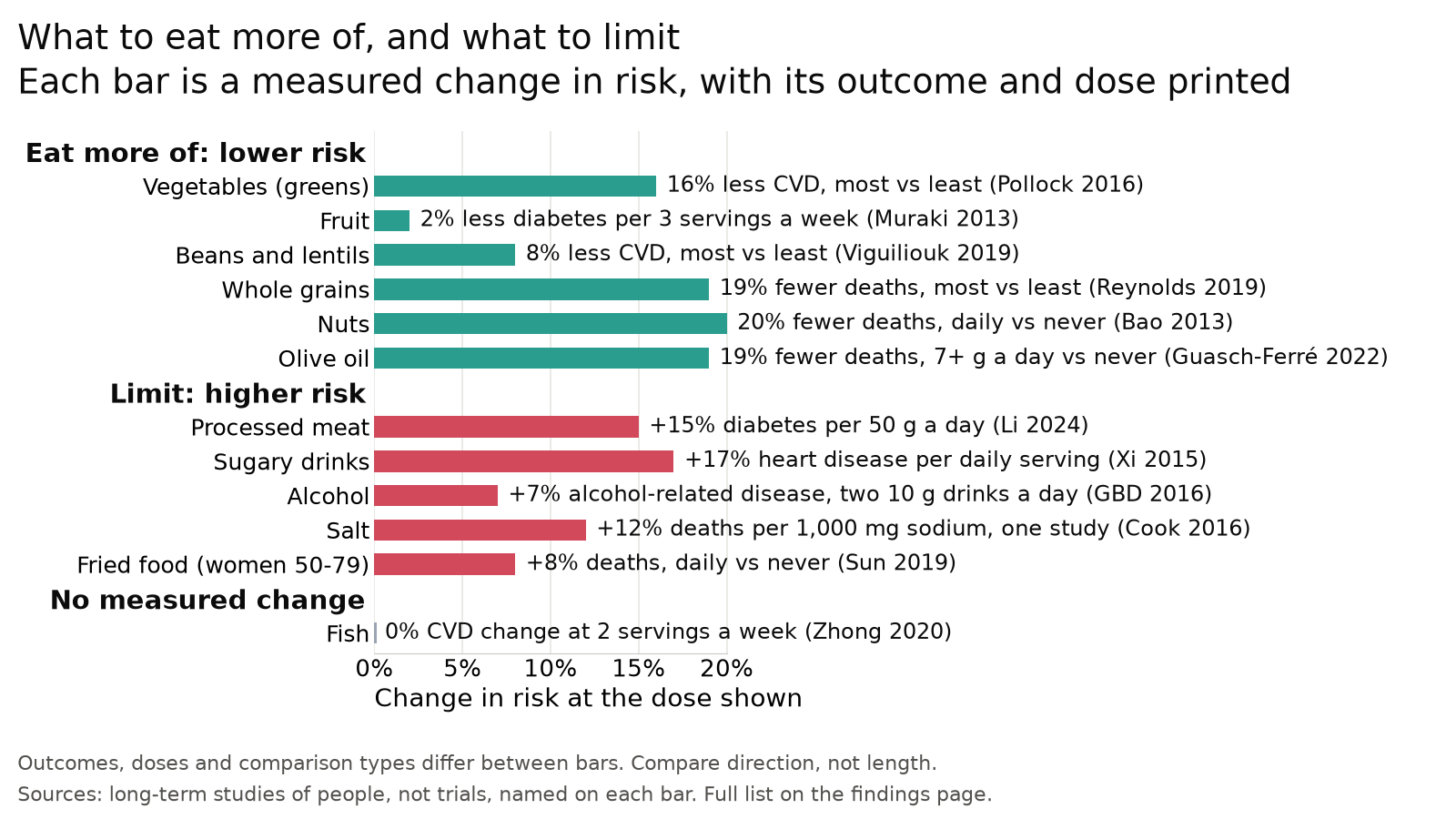 Outcomes, doses and comparison types differ between bars. Compare direction, not length.
Ranked by size of effect, then strength of evidence. The ranking is a judgment:
- Eat food that isn’t calorie-dense, and eat it slowly.
- Fill the plate with fiber and protein.
- Don’t drink your calories.
Rules 4 to 7 sit in dropdowns below: saturated fat, alcohol, salt, processed meat.
What the words mean
- Processed meat: meat preserved by salting, curing, smoking or fermenting. Bacon, ham, hot dogs, sausage, deli meat, salami. Deli turkey and chicken sausage count, with less evidence. “Uncured” still counts. Smoked or cured fish is outside this evidence. Cantonese-style salted fish is a separate Group 1 carcinogen.
- Calorie-dense: over 4 kcal per gram (chips, cookies). Under 1.5 is low (vegetables, fruit, beans). Chicken breast, at 1.65, is medium.
- Added sugar: sugar put in. The sugar in whole fruit does no measured harm.
- Refined starch: white flour and white rice, and what is made from them.
- Liquid calories: any drink with calories: soda, juice, smoothies, alcohol.
- One drink: 12 oz beer, 5 oz wine or 1.5 oz spirits, 14 g of alcohol in the US. The alcohol chart counts 10 g drinks.
- CVD: cardiovascular disease, heart and blood-vessel disease.
- Ultra-processed: the NOVA label. A rough proxy, not a measurement.
Disclaimers
- General population only. Kidney disease, inflammatory bowel disease, or medication that changes how your body handles potassium: the protein and fiber points need a clinician.
- Not medical advice.
What varies by person
- Salt: a 2023 crossover tested 213 adults aged 50 to 75. On low salt, mean blood pressure fell a median 4 points (middle half 0 to 8). 73% dropped, 46% by 5 or more.
- Weight: the diabetes risk of BMI 30 in white adults comes at BMI 23.9 in South Asian adults. Chinese 26.9, Black 28.1.
- Genes and diet: obesity-risk gene carriers lost weight equally well on the same diets. Genes change the start, not which diet works.
- Blood sugar after a meal: it varied 68% between people eating the same meal. A diet tailored to it lost no more weight than low-fat.
- Saturated fat: ApoE4 carriers cut cholesterol more when they cut it. Check a lipid panel 6 to 8 weeks after the swap.
- Alcohol: people who flush after one drink (common in East Asia) had higher drinking-linked cancer risk.
- Protein: extra protein stopped adding muscle somewhere between 1.0 and 2.2 g per kg a day. The best estimate is 1.6, not a firm line. It added less per year of age, yet over-65s need more, not less (below).
- Lactose: 12 to 15 g, about a cup of milk, is tolerated by most people with lactose malabsorption.
- Fructose: 25 g at once was malabsorbed by 10% of healthy adults, 50 g by 80%.
1. Eat food that isn’t calorie-dense, and eat it slowly
You eat a steady weight of food each day, not a steady number of calories. Dense food packs more calories into that weight.
 Source: USDA, per 100 g.
- Water and fiber undo it: vegetables, fruit, beans, soup, potatoes, lean meat.
- Label test: over about 400 kcal per 100 g is dense. Under 150 is not.
- Nuts and olive oil are the exception (594 and 884 kcal per 100 g). Part of the calories in nuts is never absorbed. In PREDIMED, 7,447 people given free nuts or olive oil had 28 to 31% fewer heart attacks, strokes and heart deaths. Weight did not rise.
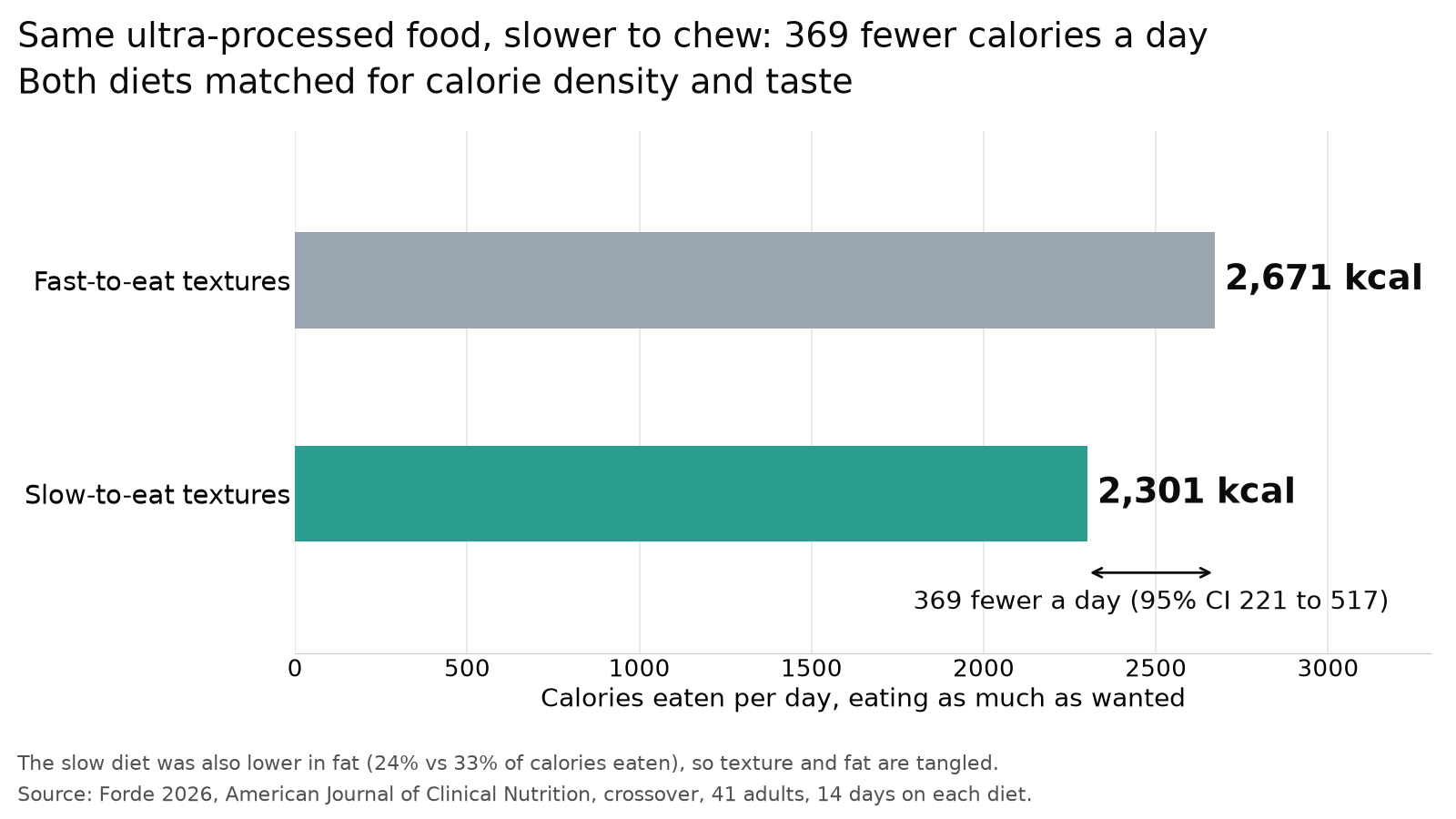 Source: Forde 2026, crossover trial, 41 adults, 14 days on each diet.
- Food you have to chew slows you down. The same menu in slower textures cut 369 calories a day.
- The slow menu was also lower in fat, so texture is not proven alone. No eating-speed target has been tested.
Why processed food makes you overeat, and how much is calorie density
Most of the measured overeating came through calorie density and taste, which processing creates. The trial could not tell whether processing adds anything on top.
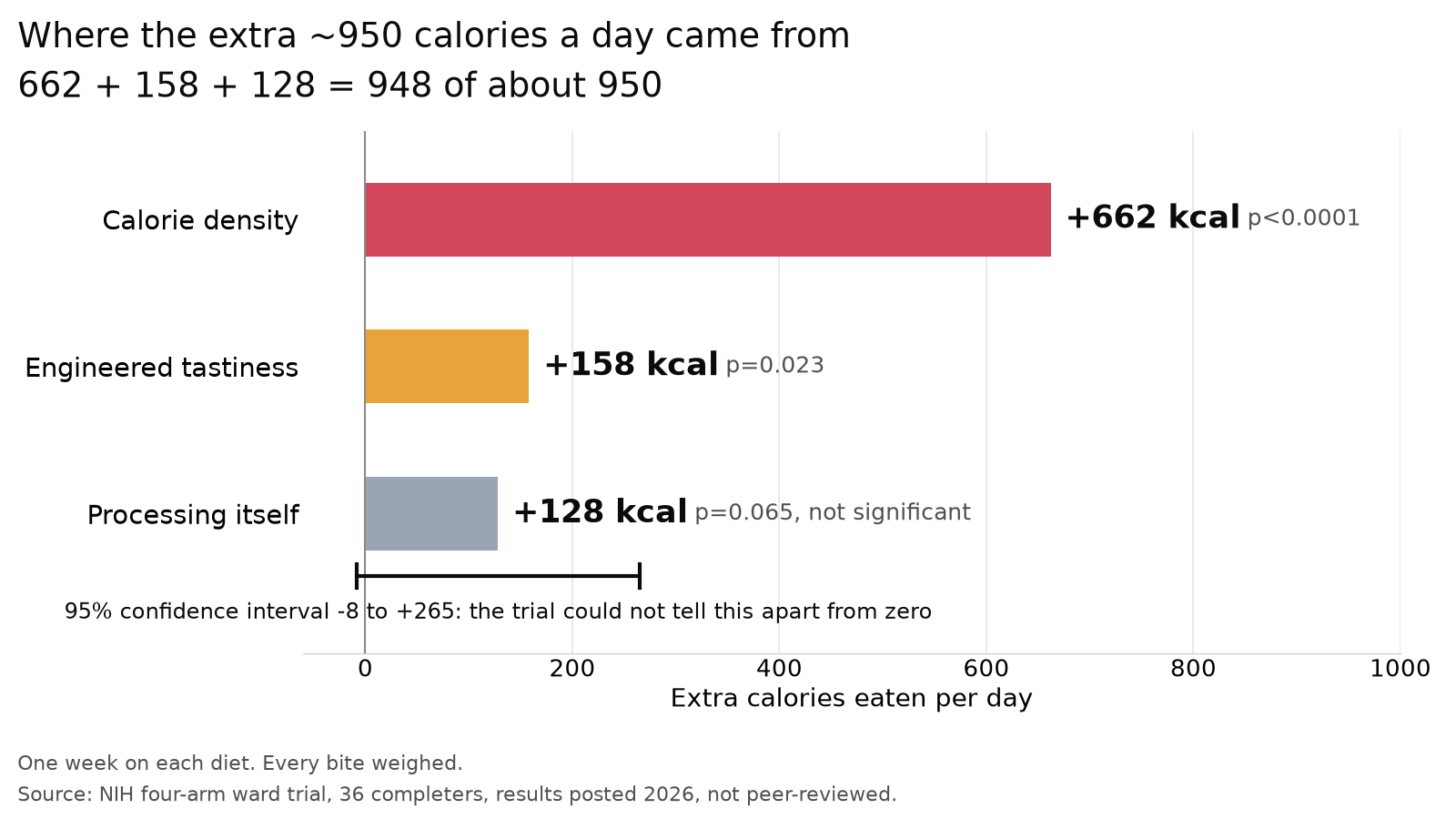 Source: NIH ward trial, 36 people, results posted 2026.
- 2019 ward trial, 20 people: every bite weighed. An ultra-processed diet drove about 500 extra calories a day.
- 2026 ward trial, 36 people: a dense, engineered-to-taste-good version drove about 950.
- 2025 UK trial, 55 people: about twice the weight loss, 2% of body weight against 1% in eight weeks.
The 2026 numbers are not yet peer-reviewed. The +128 could be anything from zero to about 265.
Does chewing speed matter on its own?
Probably, but the clean proof is short.
- 2023 trial, 18 people, density matched: harder-textured food cut eating speed 85% and intake 33%.
The 2026 diets in the chart also differed in protein.
Objections to rule 1, and whether it survives
- Short trials. Weight moved 1% in 8 weeks, or not at all. Narrowed: these are intake numbers, not weight.
- Carbs, not density. Low-fat beat low-carb by 689 calories a day in a 2021 ward trial. Survives.
- Processing itself harms. NOVA’s authors call the whole bundle the harm. Processing alone added +128 kcal a day, zero to about 265. Narrowed: avoiding ultra-processed food is a fair shortcut.
- Low-carb for diabetes. It raised six-month remission to 57% from 31%, less by a year. At equal calories sugar changed weight 0.04 kg. Narrowed: with diabetes, ask about cutting refined carbs.
2. Fill the plate with fiber and protein
Most people eat about half the recommended fiber. The highest-fiber eaters die 15% less often.
 Source: Reynolds 2019, all-cause mortality, 10 long-term studies.
- US adults average about 16 g a day. Aim for 30 g.
- Beans, lentils, oats, whole fruit and vegetables get you there.
- Ramp up over a few weeks or you get gas.
Why fiber is the best-supported thing on this list
Fiber has the best long-term evidence here.
- Reynolds 2019 pooled 185 long-term studies and 58 trials.
- Highest-fiber eaters had death rates 15% lower (RR 0.85).
- The trials did not measure death. Fiber moved weight and blood pressure a little: about 0.4 kg and 1 point.
The death half is observational, so high-fiber eaters may just be healthier in other ways.
Protein
Protein protects muscle when you lift while losing weight. It also cuts appetite.
- A palm-sized portion at each meal: about 1.6 g per kg a day if you lift (the best estimate, with the true plateau anywhere from 1.0 to 2.2). Over 65, at least 1.0 to 1.2 g per kg, 1.2 or more if active.
- Eggs, chicken, fish, Greek yogurt, beans, tofu.
The protein trials: muscle with lifting, and a smaller appetite
Protein earns its spot for muscle, and it trims appetite.
- 2016 trial, 40 men, four weeks, 40% calorie cut, heavy training six days a week.
- Higher protein gained 1.2 kg of lean mass and lost more fat. Lower protein gained 0.1 kg.
- 2005 trial, 19 adults: raising protein from 15% to 30% of calories cut intake 441 calories a day.
An extreme setup. It shows protein protects muscle under stress, not that more is always better.
Objections to rule 2, and whether it survives
- Fiber marks healthy people. Bran did not prevent bowel polyps. Narrowed: partly a marker. Eat whole food, not added fiber.
- Fiber hurts some guts. Weak studies only. Survives.
- Protein needs training. 49 lifting trials: +0.3 kg lean mass. Narrowed.
- Protein shortens life. One recall study, 75% more deaths at 50 to 65, reversed over 65. Survives.
3. Don’t drink your calories
Your body compensates poorly for calories you drink. It eats little less later.
- Water, coffee, tea. Target: zero sugary drinks a day.
Why drinking calories doesn't fill you up
Solid calories get eaten back at later meals. Liquid ones don’t.
 Source: DiMeglio and Mattes 2000, 15 people, 4 weeks each.
- Separate 10-week study: fructose and glucose drinkers gained similar weight, but fructose put the fat in the abdomen.
That fructose study fed a quarter of all calories as pure fructose, so read it as a mechanism, not as a can of soda.
Objections to rule 3, and whether it survives
- One small trial. In 641 children over 18 months, sugar-free drinks gained 6.35 kg against 7.37. Narrowed: drinks are compensated less, not ignored.
- Diet drinks beat water. One industry-funded trial: 6.21 kg lost against 2.45. Survives.
- Cutting soda does little. Effects are small. Industry-funded reviews were five times likelier to find no link. Survives.
The rest, ranked
4. Swap saturated fat for unsaturated: 17% fewer heart events across trials, deaths unchanged
The four core trials that swapped saturated fat for vegetable oil cut heart events about 30%. Across all trials (Cochrane 2020): 17% fewer events, no change in deaths.
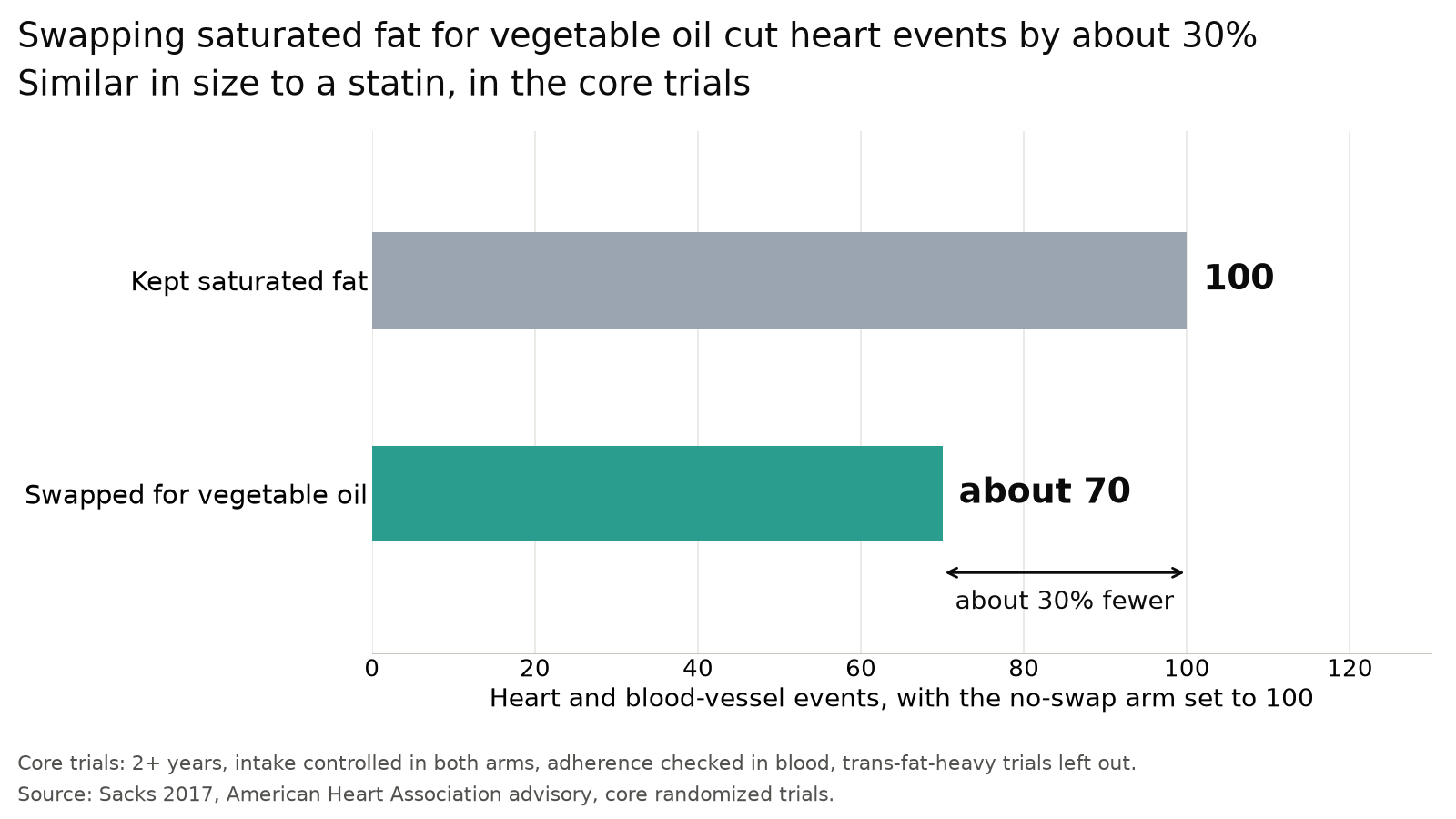 Source: Sacks 2017, American Heart Association advisory, core randomized trials.
- Cook with olive or vegetable oil instead of butter or lard. Each 5% of calories moved this way went with about 10% less coronary disease in trials.
- The swap is the point. Butter traded for white bread or sugar buys nothing.
- Two older trials found more deaths on vegetable oil. One used trans-fat margarine, and the reanalysis is disputed.
Would move up: a trial that cuts deaths, not only heart events.
5. Drink less alcohol: no protective dose proven, risk climbs from two drinks
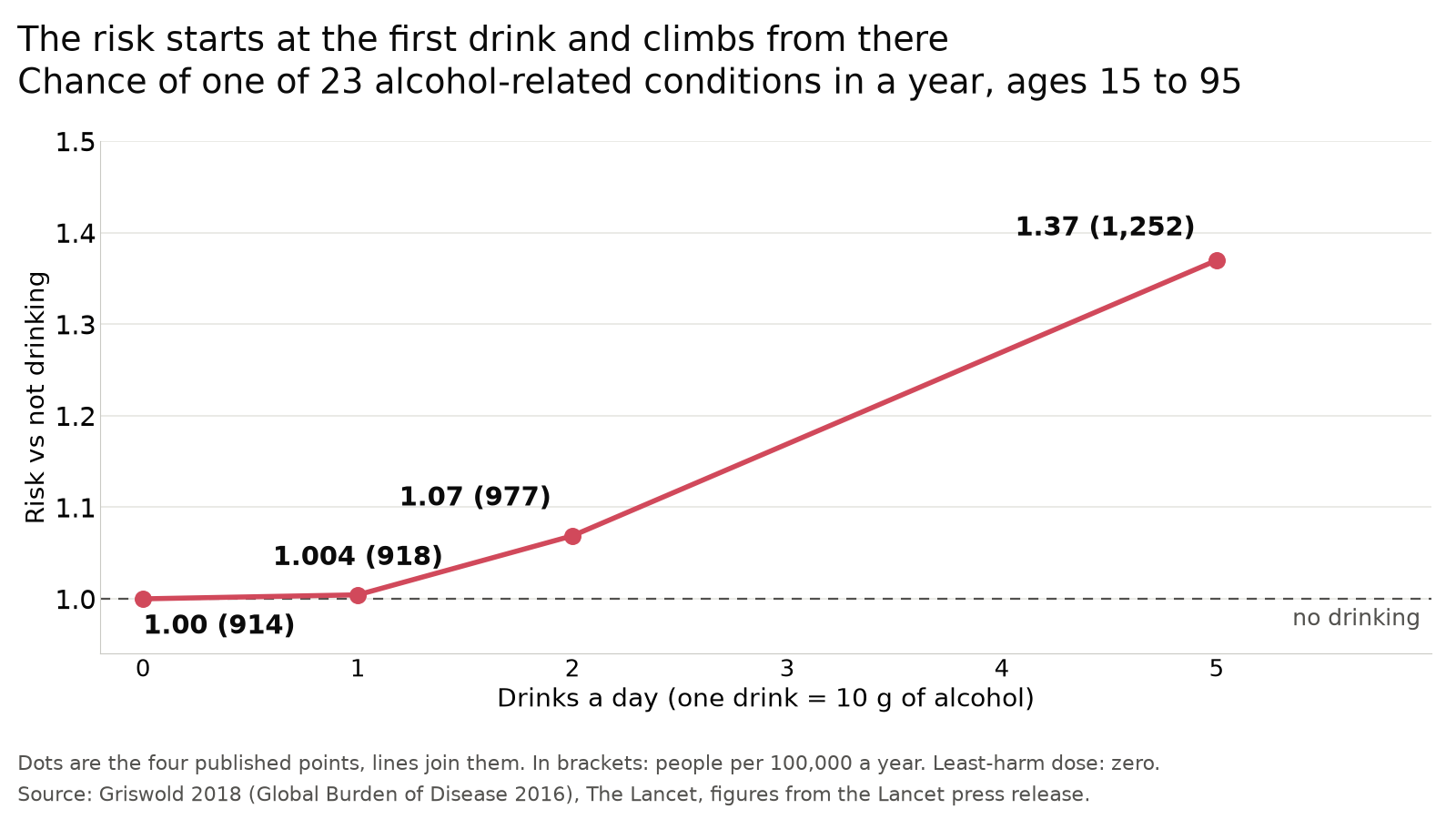 Source: Griswold 2018, Global Burden of Disease 2016, Lancet press release figures. One drink here is 10 g.
- One 10 g drink a day added 0.4%. A US drink is 14 g, so two US drinks sit between the 1.07 and 1.37 points.
- A 2020 update put the least-harm dose at zero for ages 15 to 39. Over 40 it was 0.1 to 1.9 small drinks a day, by region.
- 107 studies: low or moderate daily drinking did not change death rates. Risk rose at higher intake, sooner in women.
- Alcohol is a proven cause of seven cancers, breast cancer among them. No safe threshold has been found.
- Genetic studies in Chinese adults, mostly men, found no stroke protection (2019). Genetically higher intake raised deaths from all causes, HR 1.07 (2023).
Doing it well: none is least harm under 40. Up to one 10 g drink a day showed little measurable risk. Risk climbs from two.
Would move up: a genetic or trial result showing harm at one drink a day.
6. Eat less salt: lower blood pressure in trials, deaths from one study
US men eat about 4,000 mg of sodium a day. The cap is 2,300 mg, and blood pressure keeps falling below it.
- There is no level where the benefit stops. Blood pressure tracks sodium in a straight line from 400 mg to 7,600 mg a day, the whole range trials have tested.
- Cutting 1,000 mg a day moves systolic blood pressure 0.4 to 1.4 points. If your pressure is already high, about 2 to 3 points.
- Potassium-rich food blunts it. On the DASH diet, rich in fruit, vegetables and low-fat dairy, the same cut moved pressure a third to a half as much.
- Fruit, vegetables, beans and potatoes carry the potassium. Seven in ten US men fall short of it.
- The death figure is one long-term study of 2,974 adults with high-normal blood pressure: 12% more deaths per 1,000 mg (1.00 to 1.26). Across intake groups the trend was p 0.30.
The studies behind the salt number
The line between salt and blood pressure is straight, with no flat part at either end.
- Filippini 2021 pooled 85 trials, over 10,000 people. The fitted curve ran straight from 0.4 to 7.6 g a day.
- DASH-Sodium 2001 fed 412 people three salt levels, 30 days each. The steepest drop, 4.6 points, came on the step from 2,460 to 1,520 mg.
- A 2021 trial in 600 Chinese villages swapped a quarter of the salt for potassium chloride. Of the 20,995 people, 73% had already had a stroke and 88% had high blood pressure. Strokes fell 14%, deaths 12%. That is less salt plus extra potassium, not salt alone.
The U-shaped studies estimated sodium from one urine sample and a formula. On the same people that formula overstated intake by 1,300 mg a day on average, most at low intakes, and turned the straight line into a U. Below 2,300 mg the evidence is blood pressure, not deaths. No trial of cutting salt alone has moved deaths.
Doing it well: stay under 2,300 mg. The biggest blood-pressure drop came on the step down to about 1,500. To test yourself, take home blood-pressure readings for a week on usual salt, then a week on low salt.
Would move up: a trial of cutting salt alone that lowers deaths.
7. Cut processed meat: 15% more diabetes per 50 g a day
The diabetes cost beats the cancer cost.

Why "as bad as smoking" is misleading, and why diabetes costs more
Processed meat is “Group 1, same as smoking.” That grouping is about how certain scientists are, not how big the risk is.
- Smoking multiplies lung cancer risk roughly 25-fold (Thun 2013). Processed meat moves lifetime bowel cancer risk from about 4% to 4.7%.
- Cancer rises about 18% per 50 g a day (IARC 2015). Diabetes estimates run from 15% to 51% per 50 g a day.
The cancer link is better established.
Label trick: “uncured” and “no nitrates added” are marketing. The meat ends up cured either way.
Why "uncured" bacon is cured bacon
The end product is the same.
- A survey of 470 retail products found no difference in leftover nitrite.
- Celery powder is concentrated nitrate. USDA does not list it as an approved curing agent, and holds it to the same nitrite limits through guidance rather than regulation.
Its nitrate content varies between batches, so the “natural” version is harder to verify.
Which meat, ranked.
Fish, then poultry, then unprocessed red meat. The gap between poultry and unprocessed red meat is small.
- Fish: no added CVD risk, and no benefit in the largest recent US studies. Two servings a week moved it 0% (Zhong 2020).
- Poultry: small and shaky. Two servings a week, 4% more CVD, partly fried chicken. 100 g a day, 8% more diabetes, and that number shrank under other models.
- Beans and tofu rank above all four. Swapping 3% of calories from processed meat to plant protein went with 34% fewer deaths (Song 2016). UK vegetarians had 22% less heart disease, 20% more strokes (EPIC-Oxford).
- Unprocessed red meat: 100 g every day for life, about 4% to 4.7% bowel cancer if the link is causal. Twice the processed-meat dose for the same bump, and rated “probably”, not “convincing”.
The studies behind the ranking
Two large studies measured all four meats the same way.
- Zhong 2020: six US long-term studies, 29,682 people, 19 years. Per two servings a week, CVD was 7% higher for processed meat, 4% for poultry, 3% for red meat and unchanged for fish.
- Li 2024: 31 long-term studies, 1.97 million adults. Per 50 g of processed meat a day, diabetes was 15% higher. Per 100 g a day, red meat was 10% and poultry 8%.
- WHO’s figure for red meat is 17% more bowel cancer per 100 g a day, if the link is causal. A 14-person panel read the same studies in 2019 and rated that evidence low certainty.
Fatty cuts add saturated fat and calories, which the ranking does not count.
Doing it well: very little processed meat, if any. Red meat up to three portions, 350 to 500 g cooked, a week (WCRF).
Would move up: a diabetes risk that settles near the 51% end of the pooled range.
Ultra-processed as a label: most of its risk is processed meat and soda
- Removing them took the risk from 11% higher to no difference for cardiovascular disease overall. Heart attacks alone stayed 6% higher.
- In two of those cohorts, 114,000 people, ready-to-eat meat, poultry and seafood still showed 6% to 43% higher death rates.
- Ultra-processed bread and cereal went with lower heart-disease risk.
Adjusting for overall diet quality shrinks what is left.
Examined: little measured harm at real doses, emulsifiers mixed
The famous scares rest on animal doses nobody eats.
 Source: EFSA 2011 and 2015 intake estimates, Shah 2017 (FDA) adult estimate, Chassaing 2022 trial dose.
- Seed oils and MSG: no good evidence of harm at cooking doses.
- Three additives earn caution: erythritol, potassium bromate, titanium dioxide. Emulsifier evidence is mixed, not null.
- Processing itself may still add up to about 250 kcal a day. The trials cannot rule it out.
The additive, seed-oil, MSG and organic evidence is on the findings page.
Organic is left out too: fewer pesticide residues, no measured health effect.
I’m not a doctor or a nutrition scientist. This is me reading papers and checking whether they say what people claim they say.